DAS and SOP in subsea cable protection workflows

Subsea cable protection is no longer just about knowing where vessels are. For years, AIS has given operators a reliable view of vessel identity, course, and speed, and it remains a critical input. But AIS can’t detect vessels operating without transponders, and it tells you nothing about what is happening on the seabed.
This is where fibre-based sensing becomes relevant. Distributed Acoustic Sensing (DAS) and State of Polarisation (SOP) turn subsea cables into continuous sensors. The challenge is converting those signals into operationally useful risk intelligence, fast enough to support action.
DAS and SOP are often described in technical terms. Their operational value is more straightforward.
DAS monitors along the cable, turning fibre into a continuous acoustic array. It detects vessel movement, trawling activity, and seabed contact through vibration and acoustic signatures. SOP measures changes in light polarisation within the fibre. Those changes can indicate drag, contact, or physical disturbance of the cable itself.
Together, they close two critical gaps:
On their own, DAS and SOP increase visibility and the volume of alerts. To support protection, they need to operate within an integrated operational context.
Most operators working with fibre sensing encounter the same pattern. DAS alerts appear in one interface, SOP events in another, and AIS and other maritime data sit on separate systems.
During an incident, those data streams must be manually correlated. Analysts are forced to answer questions such as:
Those are questions about intent and context, and no sensor can answer them on its own. The data exists. What's missing is coherence.
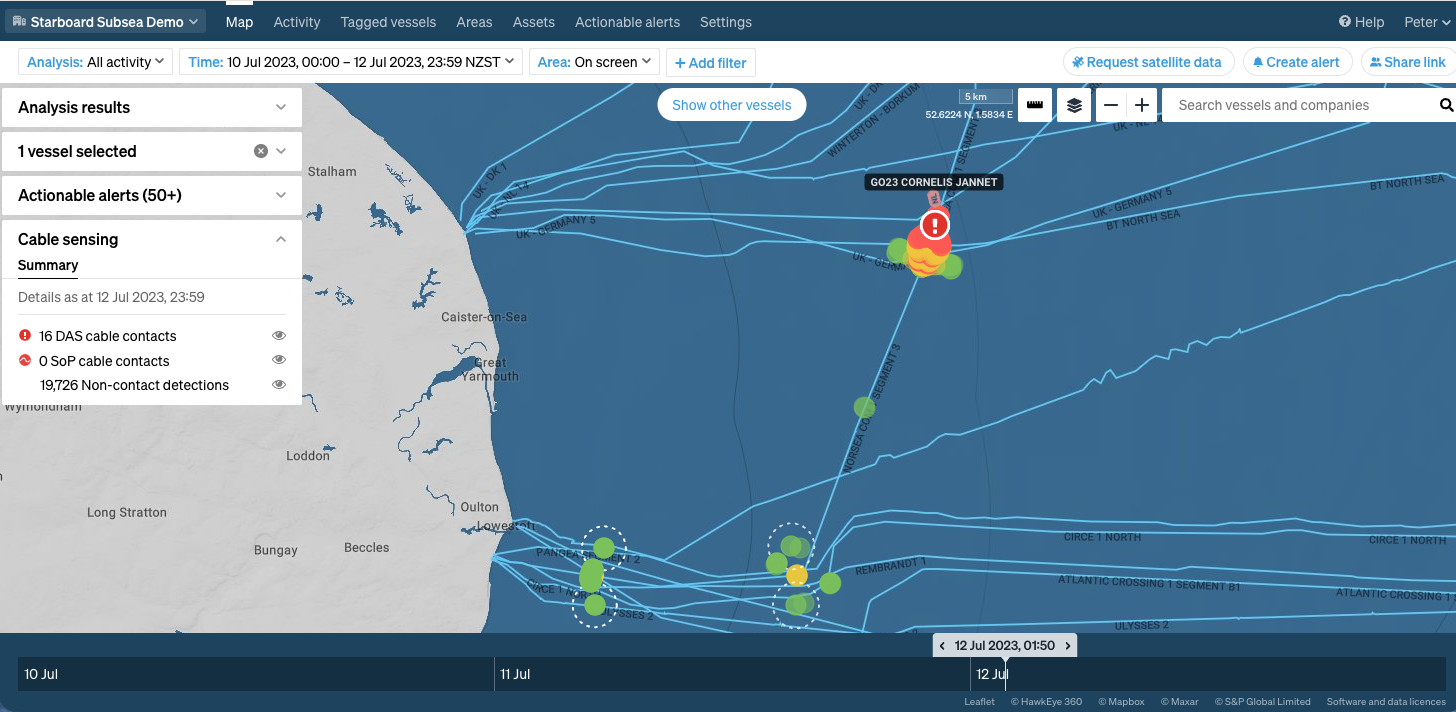
One approach is to treat DAS, SOP, and AIS as components of a single operational picture rather than separate systems. In practice, this means:
All data is time-synchronised and geo-referenced within a single view. When reviewing an alert, an operator can answer four questions at a glance:
The objective is to present the right combination of data so that risk is easier to interpret and action is clearer. This is what Starboard Subsea is built to do.
We already have this up and running in operator environments. Through our work with Tampnet, DAS and SOP feeds are integrated with vessel intelligence in a single operational view used by their analysts. This enables teams to correlate vessel behaviour with what the cable is experiencing by linking acoustic activity, physical disturbance, and vessel movement in near real time.
The emphasis is on providing sufficient context to cut through the noise and assess risk earlier and more accurately.
When DAS and SOP are integrated into a broader risk model, they move beyond traditional alerting. They support operators to:
This is the distinction between adding sensors and improving decision-making. More sensors increase data volume. Integration improves the quality of decisions.
Experience across subsea operators and sensing partners points to several consistent principles.
Integration over add-ons. DAS and SOP need to be treated as core inputs into a subsea risk model, not as isolated systems bolted on after the fact.
Context for every alert. A DAS or SOP signal without vessel behaviour and route context forces manual correlation. The operational unit of value is a combined view of vessel, behaviour, and cable response.
Prevention as the objective. The purpose of fibre sensing is not only improved forensics, but earlier detection, enabling operators to warn, adjust operations, or intervene before an incident escalates. This aligns with the way fibre-optic sensing is now being discussed at ICPC and in regional resilience strategies: as a tool for earlier intervention, not just better forensics.
DAS and SOP extend visibility below the surface. Their value depends on how effectively they are combined with vessel intelligence and interpreted over time.
Treating fibre sensing as part of a broader intelligence layer by connecting what happens on the seabed with how vessels behave across a route, produces not simply more data, but a clearer basis for earlier, more confident intervention.
Learn more about how Starboard is the common operating picture for the maritime world.