Australia’s $60 billion visibility gap in offshore decommissioning

Australia is entering a long period of offshore oil and gas decommissioning. Asset owners, operators, and marine contractors face significant logistical, safety, and liability challenges. Engineering teams often focus on plugging wells and removing structures, while a significant, yet underestimated problem sits in the background. When production stops and people leave a site, the area becomes harder to monitor, exposing aging assets to inadvertent damage.
Decommissioning teams often refer to this as the “twilight period”. It’s the stretch between cessation of production and the full dismantling of infrastructure. Assets sit unattended while fishing vessels, merchant ships, and other users move through the same waters. The National Offshore Petroleum Safety and Environmental Management Authority (NOPSEMA) still expects operators to manage risk to “as low as reasonably practicable” (ALARP), yet the practical ability to observe day-to-day activity reduces once crews are gone.
This can lead to what many refer to as silent incidents. A trawler might work close to a pipeline. A vessel might anchor near a wellhead. These moments often go unnoticed at the time and may only appear later when a survey finds something out of place, or worse, a leak surfaces. When that happens, operators face unexpected inspection and remediation work, possible schedule changes, and questions about oversight. Those surprises add cost, extend campaigns, and place pressure on already tight decommissioning budgets.
Traffic patterns in the Gippsland Basin illustrate this challenge. Once the most prolific oil and gas region for Australia, reserves in the area have been in decline, and complex decommissioning efforts are underway for unproductive assets. Even after production ceases, fishing and transit activities continue around vulnerable pipelines and wellheads. Potential consequences of these interactions and the strain they place on aging assets are often missed. Operators describe the late-life period of these vulnerable oil and gas assets as being difficult to track, especially when assets sit unattended for long stretches.
Decommissioning is a maritime awareness challenge as well as an engineering challenge. Teams need a clearer view of who is moving through their fields and how behaviour changes over time, especially when no personnel are present.
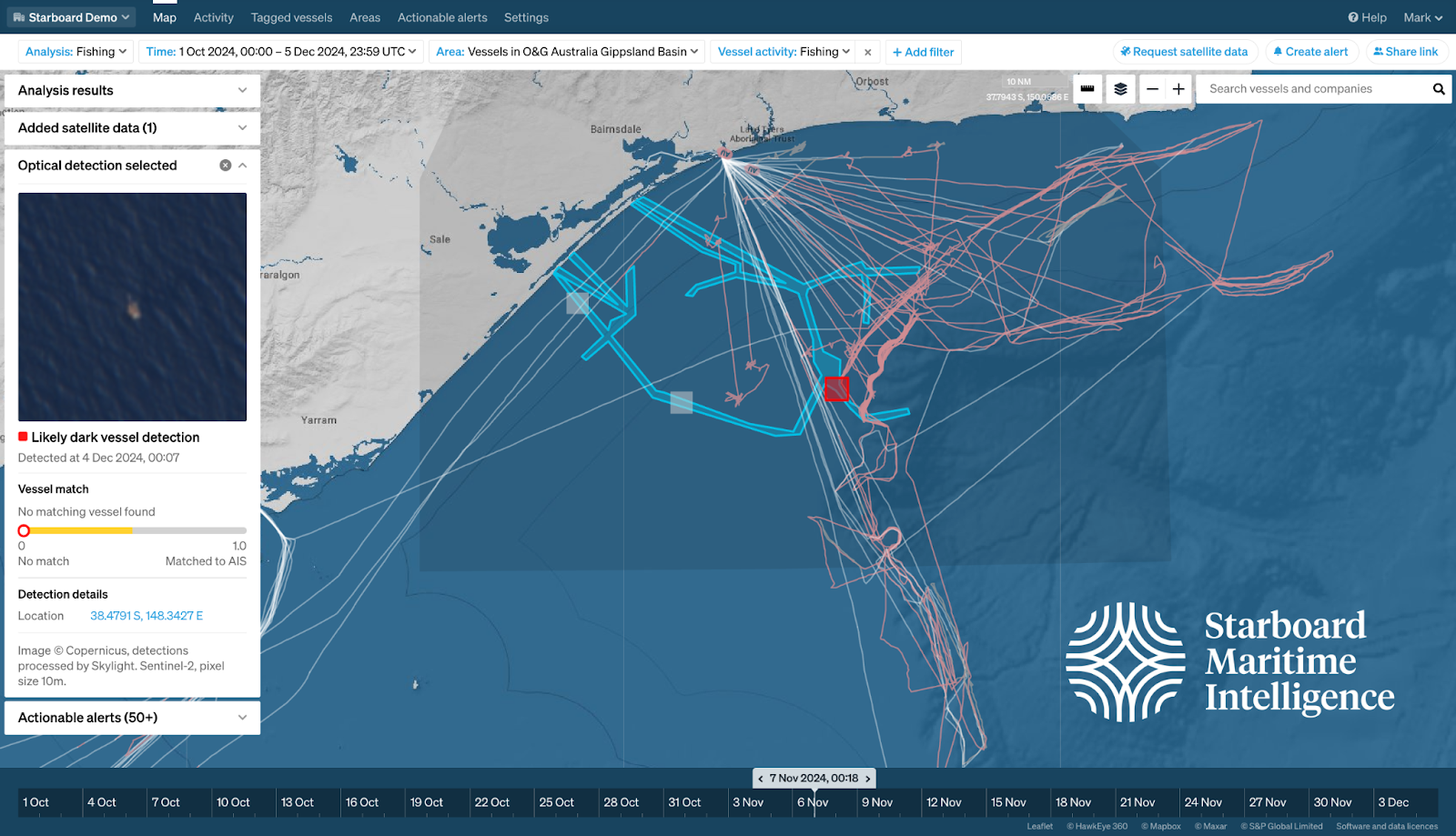
Starboard supports these projects by providing continuous maritime domain awareness. Our aim is to help project teams understand what is happening around unattended assets so they can manage risk, plan work, and meet regulatory expectations.
Our approach focuses on behaviour, not just vessel location. Starboard’s machine learning and AI models identify and then alert for behaviour that indicates fishing, loitering, or other anomalous movement. Early awareness lets marine coordinators and decommissioning teams respond in a measured way. Sometimes a simple radio call is enough. Sometimes it prompts a closer look before work starts.
This information also supports planning during active campaigns when decommissioning spreads draw a mix of tugs, barges, supply vessels, survey teams, fisheries, and transiting ships. A consolidated picture helps teams plan sequences and manage simultaneous operations (SIMOPS) within limited weather windows.
The service doesn’t replace guard vessels, inspections, or existing marine assurance practices. It gives teams better context so they can use their time and resources where they matter most.
The approach draws on work we’ve done with subsea cable operators and other marine infrastructure owners in busy, high-risk waters where long, unattended assets and dense vessel activity are common.
In practice, this means a single, continuously updated view of vessel activity around unattended assets, with behaviours of concern highlighted for marine coordinators and decommissioning teams.
Maritime intelligence helps at several stages:
After production stops, assets remain in place for months or years. Real-time visibility helps teams understand how traffic patterns evolve and where vessel interactions are more common.
Campaigns involve many moving parts. Heavy lifts, support vessels, environmental constraints, and close working distances all add complexity. A clear view of the operating area helps teams plan and work safely.
Operators still need to confirm seabed clearance and detect any later interactions with residual infrastructure, especially where long-term liability remains or where the site may be repurposed for activities such as carbon capture and storage.
Across all phases, the goal is consistent: provide a common operating picture of activity so teams can make informed decisions.
Operators must show that risks are being managed ALARP throughout late life and decommissioning. Insurers also expect evidence of oversight, particularly when assets are unattended.
Starboard provides historical and real-time information that can support safety cases, environment plans, decommissioning submissions, and end-of-field liability assessments. It offers a factual record of how the area has been monitored and how potential interactions have been addressed, and creates an auditable trail that can be shared with regulators, JV partners, and insurers when questions arise.
This helps teams demonstrate diligence without requiring continuous physical presence.
Decommissioning involves many uncertainties. Maritime activity shouldn’t be one of them. Better awareness of the water around unattended fields helps operators and contractors focus on the work in front of them and meet their obligations with confidence.
You can’t manage what you don’t monitor. Visibility gives decommissioning teams a steadier footing through a complex and often lengthy process.
If you want to see how intelligent monitoring can help across the lifecycle of your assets, email kaan.gunes@starboardintelligence.com or fill out the form below.
Learn more about how Starboard is the common operating picture for the maritime world.