Intelligent prevention–a new approach to subsea cable protection.
January 26, 2026
·
8 minute read
Peter Harvey
This article is the third in a series by Senior Product Owner Peter Harvey on how subsea cable protection is evolving. In the first article, “The end of the benign seabed: Why AIS monitoring is no longer enough,” we examined why traditional assumptions about accidental damage and cooperative vessel behaviour no longer hold. In the second, “Subsea cables: the threat you can’t see vs the sensor you already own,” we explored how distributed acoustic sensing (DAS) allows operators to detect seabed interaction that does not appear in AIS data. This article brings those ideas together. It describes a practical protection model that moves beyond monitoring and alerts towards earlier, intelligence-led prevention.
Most damage to subsea cables comes from visible and routine operations rather than vessels operating without AIS. Fishing—particularly trawling and dredging—presents the highest statistical risk, followed by anchoring. These activities are typically lawful and broadcast on AIS. The operational challenge is determining when and where they become hazardous for a specific cable route.
Several trends have made that task more complex:
Demand for bandwidth and uptime has increased as data‑intensive and AI‑driven services expand.
Pressure on fisheries is pushing vessels into new areas and along unfamiliar routes.
Geopolitical tension has increased scrutiny of activity near critical infrastructure.
Repair and installation capacity remains constrained, increasing the operational and financial impact of each fault.
Together, these factors raise the cost of avoidable incidents and reduce the margin for delayed detection. Subsea cable protection now relies less on spotting incidents after the fact and more on identifying elevated risk early enough to intervene.
A layered approach to subsea cable resilience
Starboard is advancing a new model that we call “intelligent prevention”—a multi-layered framework designed to move the industry from reactive monitor-and-repair approaches to proactive, intelligence-led protection.
This article introduces the first four layers of intelligent prevention. Together, they form the “brain” of the system by turning large volumes of complex ocean data into a single operational view. Normal vessel patterns are distinguished from behaviours of concern, delivering decision-ready insight that gives operators time to deter or coordinate a response.
Most cable operators still rely on monitoring approaches built around basic data and fixed rules. These typically include:
AIS monitoring to establish vessel position and movement.
Geofences drawn around the cable route.
Rule-based alerts triggered by simple thresholds, such as low speed within a buffer zone.
This provides a basic level of awareness, but it offers little context. A vessel moving slowly near a cable might be fishing, sheltering, waiting for a pilot, or drifting. Rule-based alerts struggle to distinguish between these activities.
The result is a mix of false positives and missed signals. Analysts spend time reviewing low-risk activity, while behaviours that warrant closer attention can be harder to isolate.
The first four layers
Intelligent prevention combines multiple sources of information to assess risk in context. Instead of treating all vessel activity equally, it focuses on where risk is higher and on which behaviours matter in those areas.
The layers are designed to work together. Some elements are in operational use, while others reflect the direction of ongoing development and cross-sector collaboration. Taken together, they provide a practical framework for intelligence-led prevention of subsea cable damage.
Layer 1: AIS, geofences, and alerts as the baseline
The first layer consists of data such as AIS, where vessels broadcast their own position and identity. This remains the foundation of most current monitoring stacks and provides essential visibility of vessel presence and movement around cable routes.
On its own, AIS offers limited insight into intent or risk. In the intelligent prevention model, it establishes baseline awareness rather than acting as the primary decision trigger.
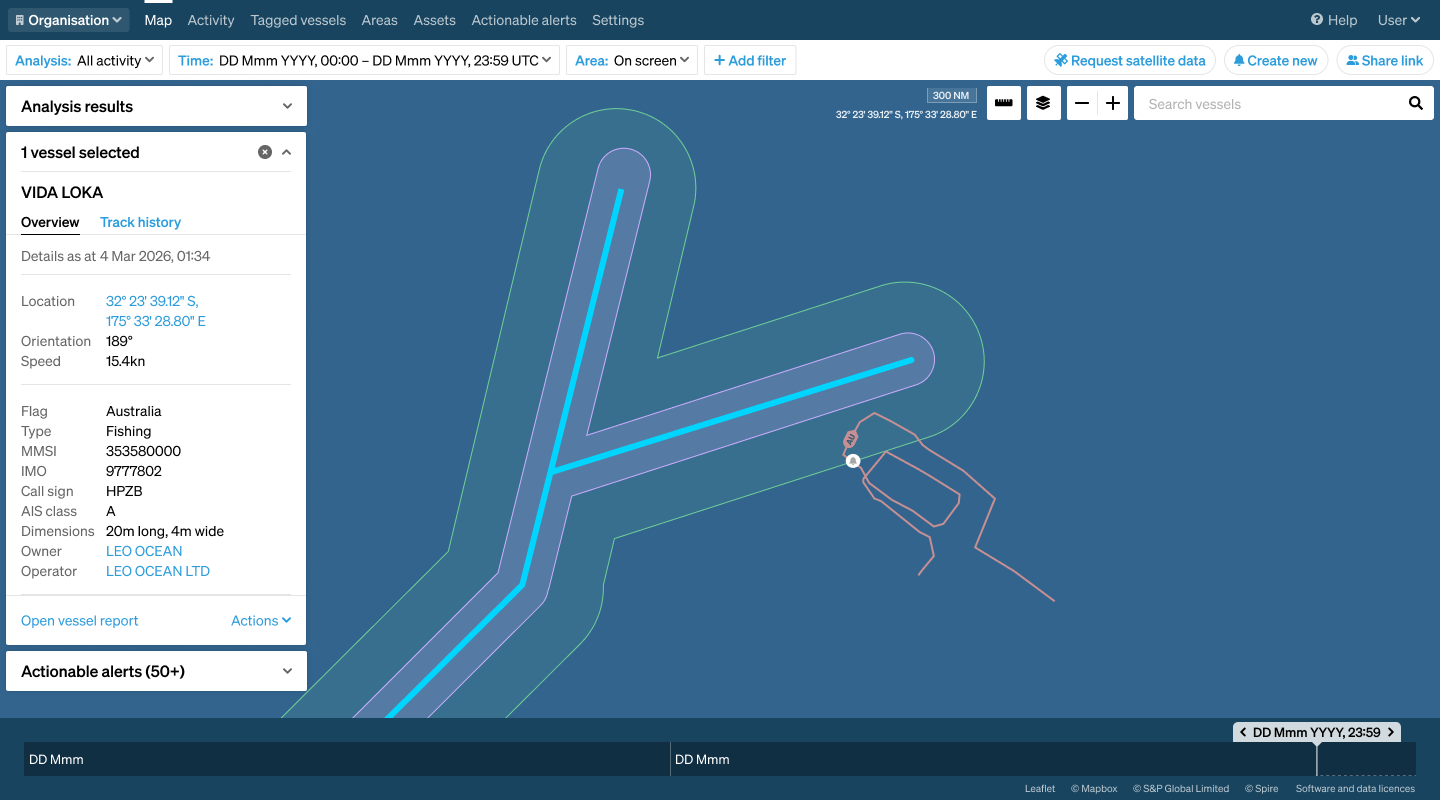
Example of a vessel transmitting AIS crossing a geofence and generating an alert.
Layer 2: Cable route risk and environmental context
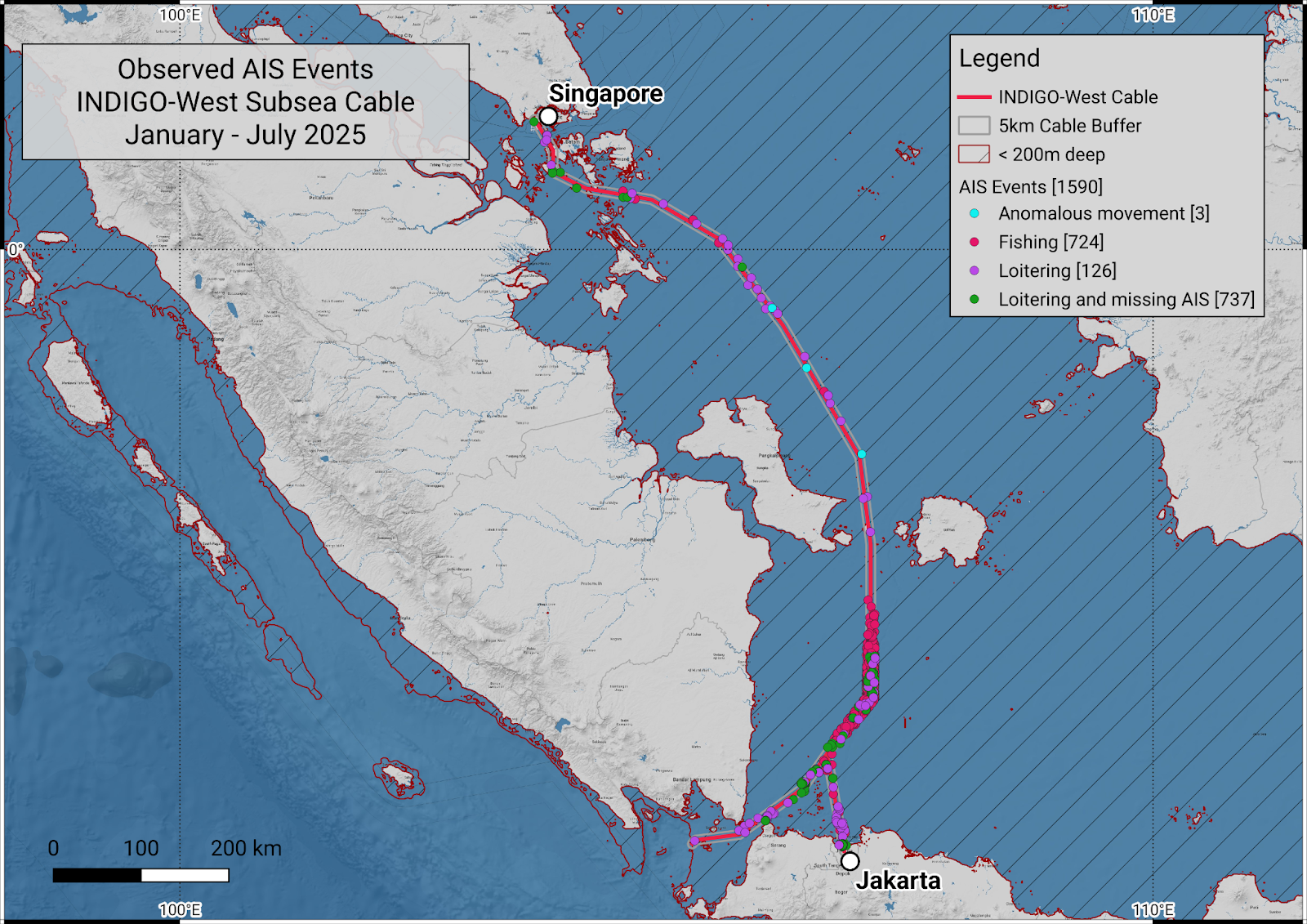
The second layer introduces route-specific context. Historical AIS data, bathymetry, and patterns of life are used to identify where a cable is more exposed to interaction and damage.
Key factors include:
Patterns of life (fishing hotspots): Seasonal trawling activity often appears consistently in the same areas, creating predictable periods of elevated risk.
Anchorage and loitering zones: Informal anchoring areas commonly develop outside ports. Where cables pass through these zones, anchoring activity becomes more relevant.
Bathymetry: Cables in shallow water (less than 50 metres) face greater exposure to anchors and bottom-contact gear.
Mapping these factors helps distinguish between lower and higher-risk segments and allows monitoring to be adjusted along the route accordingly. This layer answers a core operational question–where does vessel behaviour matter most?
Analysis of a subsea cable segment in shallow water, showing potential anchoring and fishing hotspots.
Layer 3: Vessel risk profiling
The third layer focuses on who’s interacting with the cable environment.
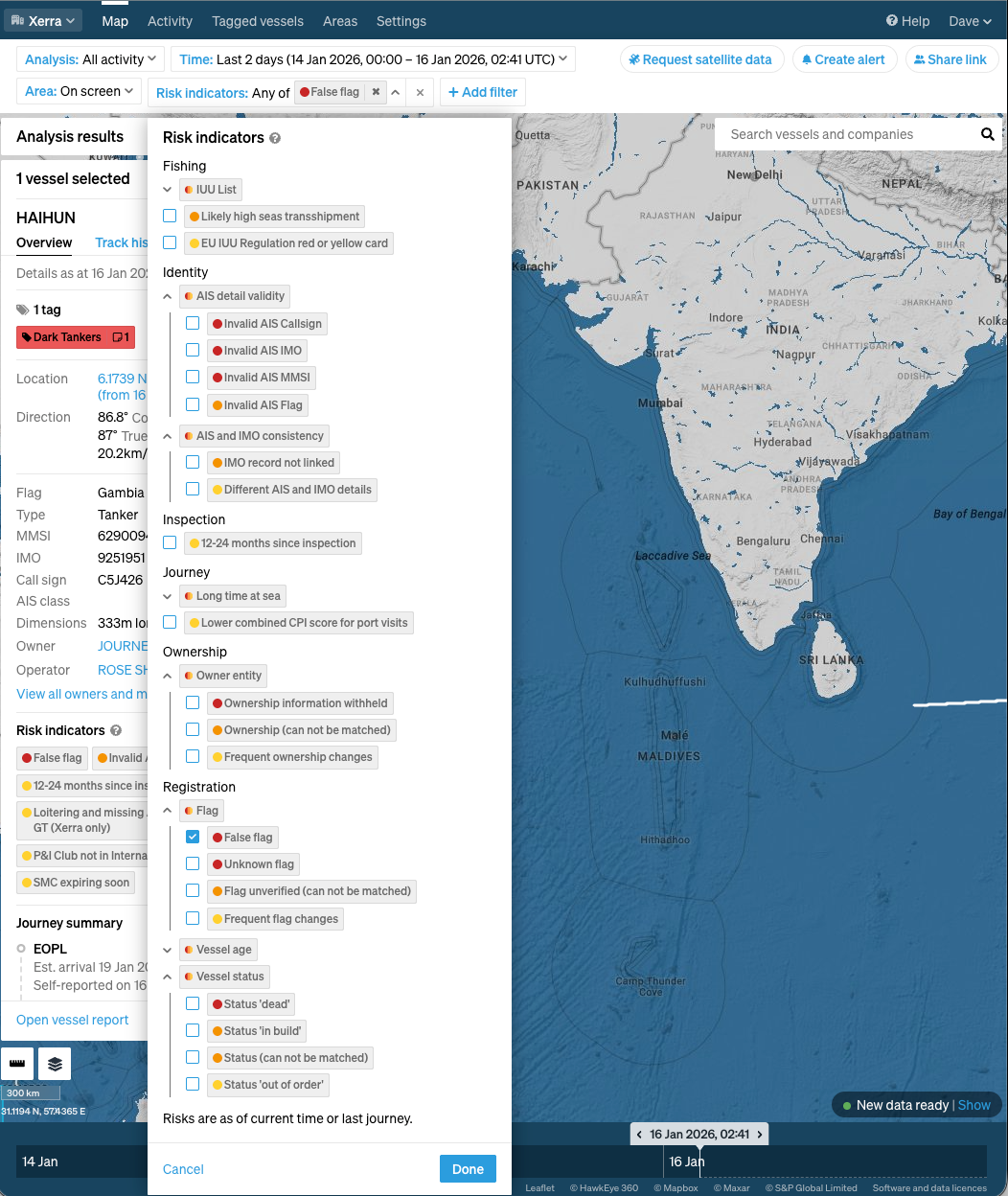
Vessel risk profiles are built using fusing open-source and commercial maritime data, including ownership transparency, flag state changes, and historical behaviour near critical infrastructure. These profiles don’t predict intent in isolation. Instead, they provide context that helps prioritise attention when vessels operate in higher-risk areas.
Analyst input is central to this layer. Vessels can be tagged based on assessment and experience, whether to highlight ongoing concern or confirm low risk. These tags persist, helping maintain continuity over time.
By combining metadata with analyst judgement, monitoring can focus on vessels that are more likely to require attention.
Development of vessel risk indicators and tagging of known vessels.
Layer 4: Behavioural analysis as an operational capability
The fourth layer reflects an emerging industry practice that supports more timely and operationally relevant assessment of risk. It evaluates how vessels behave over time, particularly when operating near higher-risk segments of a cable route.
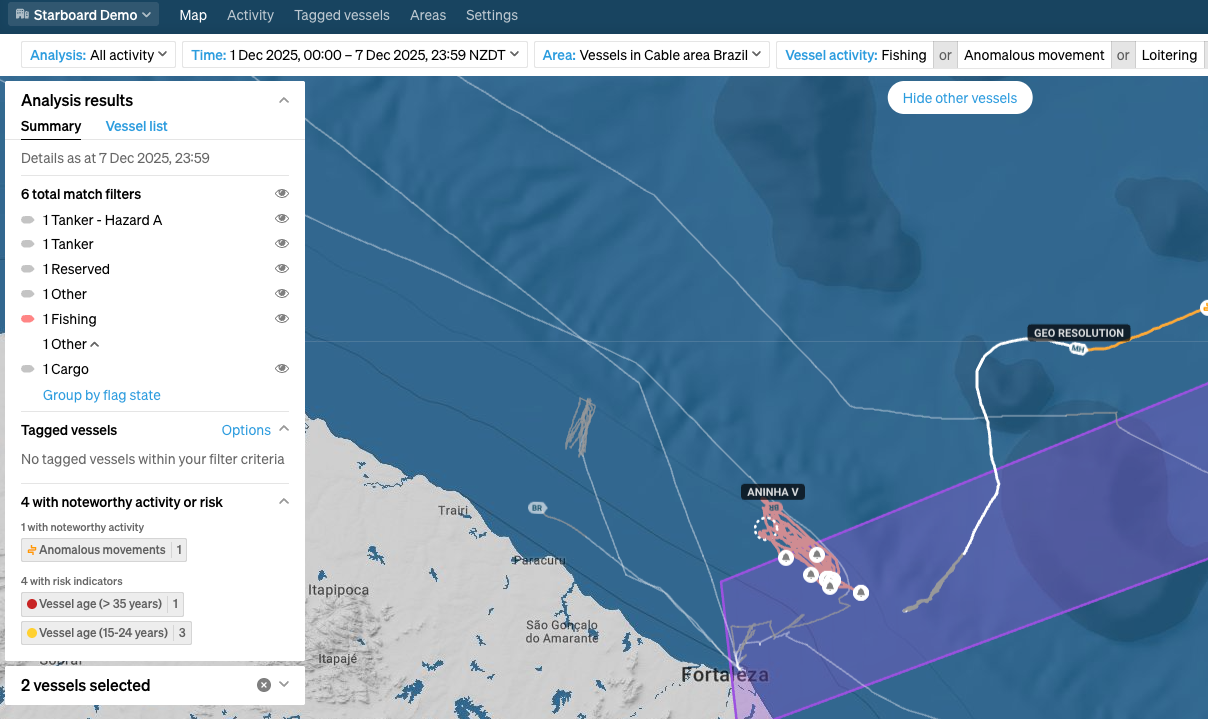
Machine learning techniques are being developed and applied to identify vessel behaviour associated with activities such as trawling, anchoring, prolonged loitering or anomalous movement near a cable route. The objective is to move beyond retrospective review and support operational decision-making in near-real time.
This analysis helps teams prioritise which activity warrants further investigation.
AIS-based behavioural models flagging fishing activity and anomalous movement within a cable area.
The complete picture: from monitoring to intelligent prevention
With the four foundational layers in place, additional prevention capabilities can be added as required. Where a route is assessed to be at higher risk from dark vessels, cable sensing can be integrated as a fifth layer to detect activity that can’t otherwise be seen.
When environmental context, vessel risk profiling, and behavioural analysis are combined, subsea cable protection becomes more targeted and predictive. Attention increases in shallow water, fishing grounds, and anchorage zones, and decreases where exposure is lower. Known low-risk traffic is deprioritised, while unfamiliar vessels or those with relevant risk indicators are easier to identify when behaviour changes.
Instead of relying on binary alerts, operators gain a clearer view of:
Where risk is concentrated along the cable route.
Which vessels warrant closer observation.
Which behaviours are relevant in a given setting.
What comes next
At this point, the intelligence engine is in place. Operators understand where vulnerabilities lie, which vessels present higher risk, and how those vessels are behaving.
Where there’s a risk of dark vessel activity, cable sensing and other detection methods can be added as an additional layer.
But intelligence without action is incomplete.
The final component of the protection model is layer 6: collaboration and intervention. In the next article, we explore how cable operators can work with governments and maritime operations centres to turn intelligence into action, enabling early intervention and damage prevention.
Get a demo
Learn more about how Starboard is the common operating picture for the maritime world.
More Recent Articles
From intelligence to intervention: what New Zealand's National Surveillance and Warning Capability means for subsea cable protection
September 11, 2026
How New Zealand is coordinating cable operators, government agencies, and maritime operations to protect subsea cables.