Huntington Beach oil spill–A preventable failure of subsea asset visibility
February 5, 2026
·
5-7 minute read
Dr. Kaan Gunes
Five years after the 2021 Huntington Beach spill, the offshore oil and gas industry continues to grapple with a fundamental challenge—how to protect critical infrastructure in increasingly congested coastal environments. Because subsea assets are often laid directly through high-traffic marine corridors, they remain highly prone to external damage from anchor strikes and extreme weather. This case study investigates these looming threats and examines how the lack of real-time, asset-specific visibility leads to costly, high-stakes decisions for operators. Using Starboard Maritime Intelligence, we reconstruct the Huntington Beach event to show how continuous monitoring can support earlier intervention while reducing uncertainty and environmental risk.
On 2 October 2021, crude oil began washing ashore along the coastline of Huntington Beach, California. Approximately 25,000 gallons were released, forcing beach closures, damaging marine ecosystems, and disrupting local tourism. Cleanup and associated costs were later estimated at more than US$160 million.
The consequences of the incident extended well beyond cleanup and remediation. The pipeline operator faced criminal penalties, civil liability, and prolonged operational disruption, while the vessels involved were ultimately linked to settlement costs totalling tens of millions of dollars.
For offshore energy operators and regulators, the Huntington Beach pipeline spill illustrates a familiar operational challenge. Pausing operations carries immediate financial cost, while continuing to operate without clear evidence of damage carries longer-term exposure to failure, liability, and enforcement action.
In this case, the pipeline operator continued operating for several months after the initiating event because available information didn’t clearly indicate external damage or justify a shutdown. When the pipeline eventually failed, the resulting release triggered emergency response, prolonged investigation, regulatory action, and significant financial settlement.
This case study applies Starboard Maritime Intelligence to the Huntington Beach incident to examine how asset-aware maritime domain awareness could have supported earlier, more confident decision-making for operators and regulators.
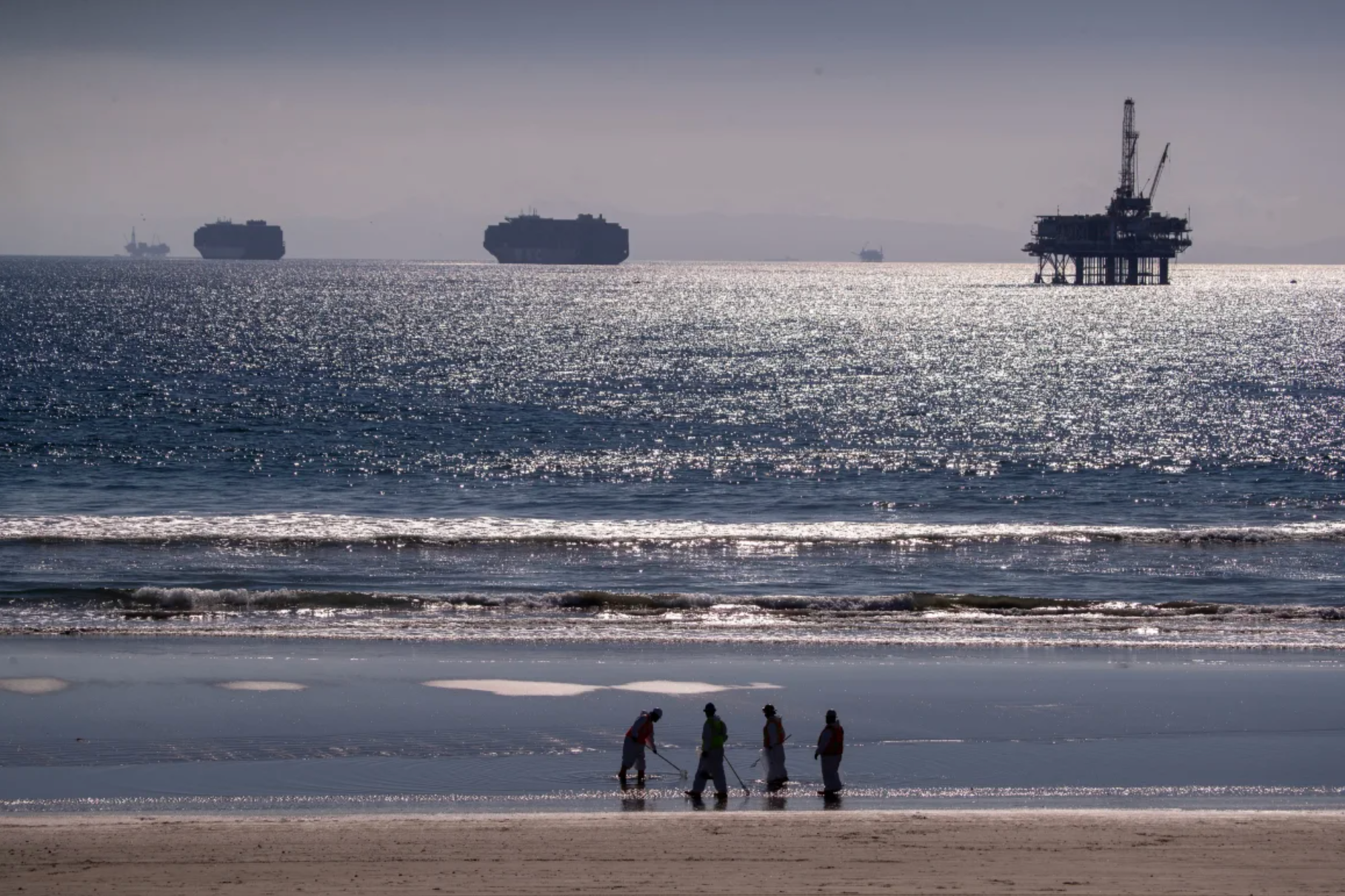
The lack of visibility into subsea interactions meant the January 2021 anchor strikes went undetected until this visible spill in October. Image: Allen J. Schaben/Los Angeles Times/Getty Images
Incident timeline
A formal investigation established that the spill was not the result of a single failure in October, but the outcome of an undetected strike that occurred months earlier and went unrecognised until after the pipeline failed.
January 2021 - Anchor strike during severe weather
On 25 January 2021, severe weather affected the anchorages offshore from the ports of Los Angeles and Long Beach. High winds, strong currents, and heavy seas coincided with congestion as large container vessels sought shelter.
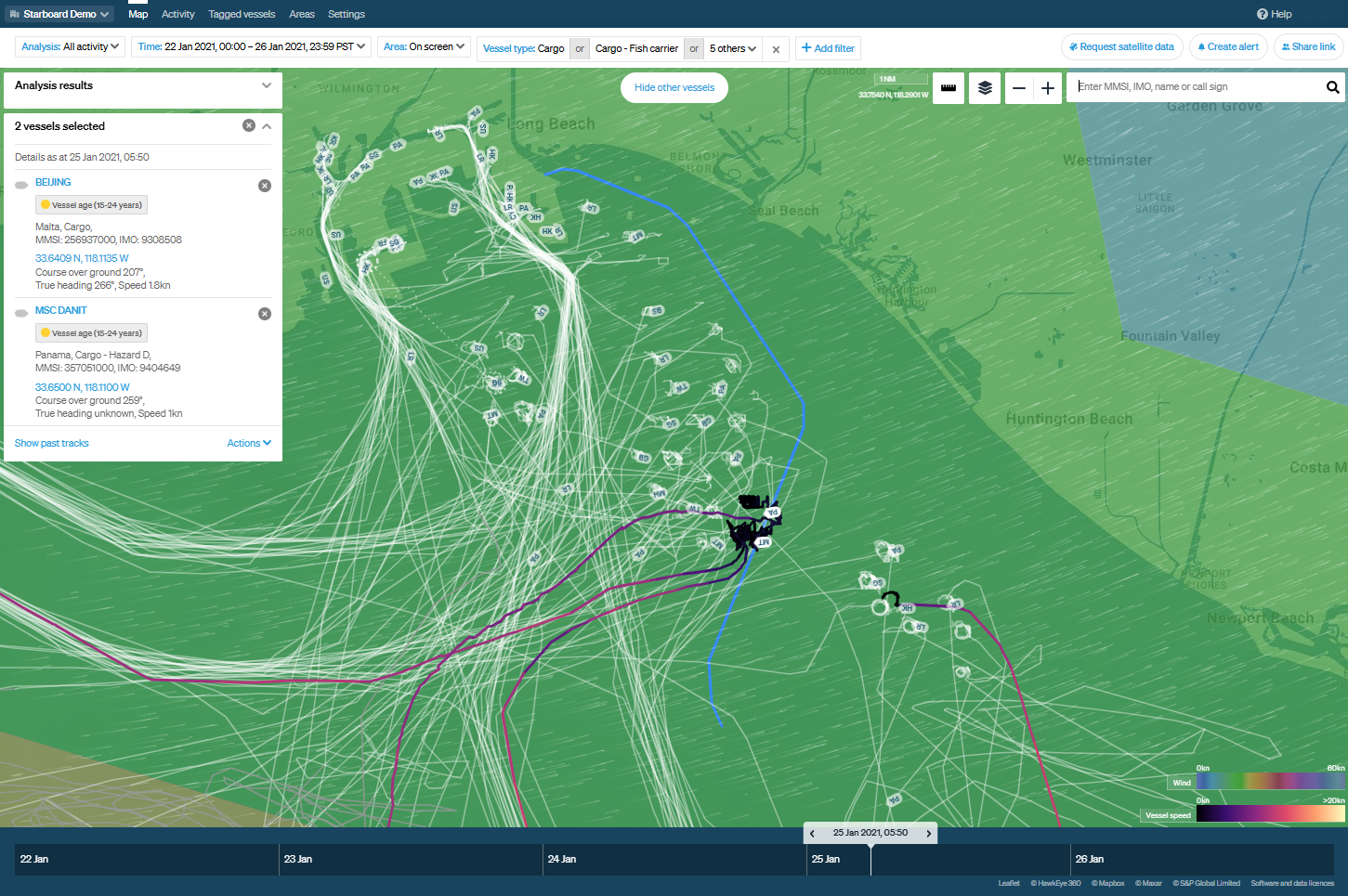
During this period, two container ships, MSC Danit and Beijing, dragged anchor while positioned near the route of the San Pedro Bay Pipeline. Later analysis by the United States National Transportation Safety Board concluded that anchor contact from both vessels struck the pipeline, with MSC Danit identified as the initiating event.
Post-incident surveys and analysis identified several key technical findings:
A section of the 16-inch-diameter pipeline was displaced from its installed position by more than 30 metres, across a length of approximately 1.2 kilometres.
The concrete weight coating and external casing were damaged, and a crack developed along the upper surface of the displaced segment.
Seafloor scars consistent with anchor dragging were identified near the damaged section.
At the time of the storm, the anchor strikes occurred below the surface and outside the operator’s direct line of sight. Although vessel movements were recorded in AIS data, there was no live system correlating vessel behaviour with the precise location of the pipeline on the seabed.
As a result, the anchor strike and the damage it caused went unnoticed.
January to October 2021 - Undetected structural damage
The pipeline continued operating for several months with compromised structural integrity. Control room data showed pressure fluctuations, but these were assessed as falling within acceptable operating limits or attributed to instrumentation issues.
Shutting down an offshore pipeline carries immediate financial cost in lost revenue and secondary operational impacts. Operators typically require clear, quantified evidence to justify halting production. In this case, the pipeline operator wasn’t notified of an external event tied to a specific location on the pipeline that would have provided that basis for intervention.
Without awareness of anchor contact or its coordinates, integrity management and inspection programmes proceeded on routine schedules rather than being directed to a defined point of concern.
October 2021- Rupture and response
In the early hours of 2 October 2021, alarms indicated abnormal operating conditions on the San Pedro Bay Pipeline. Control room personnel initiated a series of shutdown and restart attempts before taking the pipeline out of service at 06:04 local time.
Automated external detection systems like synthetic aperture radar (SAR) satellites were not in use at the time, and confirmation of the release relied on manual observation. Later that morning, a contractor vessel conducting routine work in the area visually confirmed oil on the surface. The operator initiated spill response procedures, and containment and recovery efforts were deployed.
An estimated 588 barrels of crude oil were released before the pipeline was isolated. The incident expanded rapidly from asset recovery to environmental and regulatory response.
Investigation and attribution
The investigation that followed involved multiple agencies, including the Federal Bureau of Investigation, United States Coast Guard, National Transportation Safety Board, National Oceanic and Atmospheric Administration, and United States Geological Survey.
Investigators used a combination of remotely operated vehicle footage, side-scan sonar, seabed mapping, ship positioning records, AIS archives, and meteorological data to reconstruct events. Correlating seabed damage with vessel movements required reconciliation across datasets held by different organisations.
During the early stages of the investigation, multiple vessels and scenarios were assessed before anchor dragging during the January storm was identified as the initiating cause. As attribution remained unresolved, public and media scrutiny intensified, and the investigation extended over several months.
Legal and financial consequences were significant. Amplify Energy, the pipeline operator through its subsidiaries, pleaded guilty to violations of the Clean Water Act and agreed to pay criminal fines, civil penalties, and compensation. The company also reached a settlement valued at approximately US$96.5 million with the owners and operators of MSC Danit and Beijing, as well as additional settlements with affected fishermen, tourism operators, and property owners.
Where the gaps emerged
Public findings from the investigation point to several technical and operational gaps that contributed to the extended period between the initial anchor strike and the eventual spill.
Fragmented operational views
Vessel anchoring and movement were monitored within port and navigational systems, while pipeline integrity was managed through separate operational and engineering tools. These systems were not integrated in a way that provided a shared, real-time view of vessel behaviour in relation to the pipeline’s actual seabed position.
Behaviour not correlated with asset proximity
Anchor dragging was recognised as a navigational risk, but observations of vessel movement were not correlated with subsea infrastructure across organisational boundaries. Without asset-aware correlation, anchor drag events near the pipeline did not register as infrastructure threats requiring follow-up.
Internal monitoring without external context
Pipeline monitoring relied on internal pressure and flow data. In the absence of a known external event and location, anomalies were difficult to interpret as evidence of physical damage. This limited the ability to prioritise inspection and maintenance activity.
Starboard view of Beijing and MSC Danit dragging anchor over the San Pedro Bay pipeline near Huntington Beach on 25 January 2021.
Analytical application of maritime intelligence
The Huntington Beach incident provides a useful reference point for examining how Starboard supports operators and regulators by integrating vessel behaviour, environmental context, and subsea asset location into a single operational view. This capability complements existing integrity management and navigation safety systems rather than replacing them.
The analysis that follows uses Starboard’s approach to correlation and replay to assess where earlier visibility could have altered inspection, response, and investigation timelines.
Asset-aware protection corridors
Subsea pipelines and cables are not always fully visible on public nautical charts, and static anchorage boundaries may not reflect the true margin of safety required under all conditions. Starboard allows operators and authorities to maintain secure, internal maps of critical asset corridors, aligned with engineering drawings and burial data.
In this case, a digital corridor could have been defined around the San Pedro Bay Pipeline and monitored continuously. As vessels approached or anchored near that corridor during the January storm, their proximity could have been assessed against the pipeline’s actual seabed position rather than charted anchorage limits alone.
This type of monitoring supports both operator awareness and regulatory oversight in high-traffic areas.
Behavioural detection of anchor dragging
Anchor dragging produces distinctive movement patterns that differ from normal drift. These include low speed, variable heading, and unintended track displacement while a vessel is nominally at anchor.
Starboard’s behavioural analytics are designed to classify such patterns automatically and associate them with nearby assets. During the January 2021 storm, this analysis could have identified emerging anchor-drag behaviour by MSC Danit and Beijing and overlaid those tracks directly onto the pipeline corridor.
By correlating behaviour with asset proximity, a navigation incident becomes an identifiable infrastructure risk while there is still time to respond.
Directing targeted inspection and planned maintenance
The ten months that the damage went unnoticed occurred largely because the operator didn’t know that the pipeline had been struck or where that contact occurred. Without location-specific information, there was no basis for ordering a focused subsea inspection.
Asset-aware records of vessel interaction can support targeted inspection of defined pipeline segments using remotely operated vehicles or divers. Earlier identification of displacement and coating damage allows remediation to be scheduled under controlled conditions, reducing downtime and avoiding emergency response.
Supporting investigation and regulatory review
Reconstructing the Huntington Beach incident required months of multi-agency analysis and correlation across disparate datasets.
Starboard retains vessel behaviour around critical infrastructure as a searchable historical record. For regulators, investigators, and insurers, this approach supports review of activity at a defined location and time window without reconstructing months of AIS and environmental data manually. Behaviour-based filtering allows analysts to focus on events such as anchor dragging or encroachment into protected corridors.
This capability supports transparent, replayable evidence when incidents occur and reduces the time required to establish what happened and why.
Implications for cross-sector critical maritime infrastructure
Incidents involving vessel interaction with subsea infrastructure are not isolated. Similar events occur globally across energy, telecommunications, and power sectors, particularly in congested coastal zones. As traffic density and weather volatility increase, adopting a more proactive stance toward prevention and early detection is becoming a baseline expectation rather than an exceptional measure.
Internal monitoring systems are essential, but they don’t always reveal when and where external damage has occurred. Integrating vessel behaviour, environmental context, and asset location into a single operational picture reduces uncertainty for both operators and regulators.
In this case, the initiating event was ultimately traced back to anchor strikes during heavy weather that went unrecognised for months. With an integrated maritime intelligence layer in place, such events can be identified as concrete, geolocated interactions while inspection and repair remain viable options.
Summary
The Huntington Beach pipeline spill wasn’t the result of a single point of failure. It emerged from the interaction of severe weather, vessel behaviour, subsea infrastructure, and limited correlation between surface activity and asset location.
For critical maritime infrastructure operators and regulators, the incident highlights the value of asset-aware maritime domain awareness as a complement to existing safety and integrity systems. Earlier visibility of vessel behaviour in relation to subsea assets supports more informed inspection, clearer attribution, and stronger oversight in high-risk maritime environments.
Get a demo
Learn more about how Starboard is the common operating picture for the maritime world.
More Recent Articles
From intelligence to intervention: what New Zealand's National Surveillance and Warning Capability means for subsea cable protection
September 11, 2026
How New Zealand is coordinating cable operators, government agencies, and maritime operations to protect subsea cables.